
There are a number of different impingements that can occur in the shoulder, but the most common is called subacromial impingement.
Your shoulder is made up of three bones: the upper arm bone (humerus), the shoulder blade (scapula), and the collarbone (clavicle).
Your arm is kept in the shoulder socket by the rotator cuff. These muscles and tendons form a covering around the head of the upper arm bone and attach it to the shoulder blade.
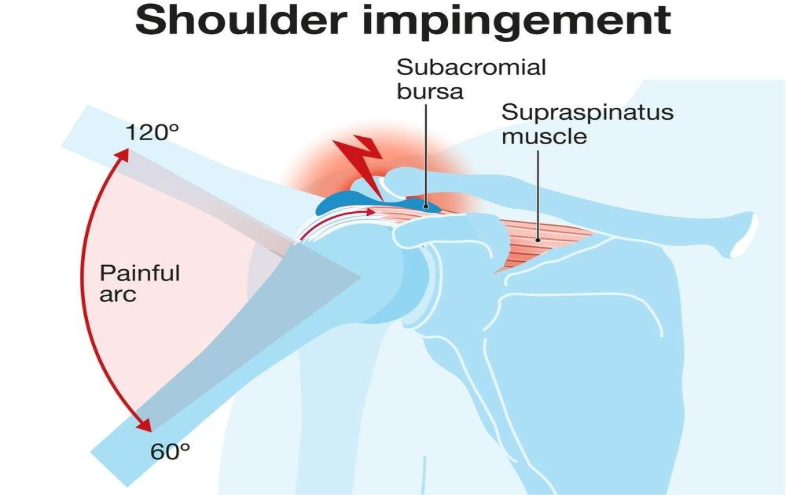
There is a lubricating sac called a bursa between the rotator cuff and the bone on top of your shoulder (acromion). The bursa allows the rotator cuff tendons to glide freely when you move your arm.
Subacromial impingement occurs when the arm is raised, and the knob on the top of the arm bone (head of the humerus) migrates upwards to squash the rotator cuff tendons and the subacromial bursa against the bony roof of the shoulder (the acromion). Tendon damage and bursitis are the result, causing shoulder pain and weakness.
Rotator cuff pain or bursitis from impingement is common in both young athletes and middle-aged people. Young athletes who use their arms overhead for swimming, baseball, and tennis are particularly vulnerable. Those who do repetitive lifting or overhead activities using the arm, such as gardening, construction, or painting are also susceptible.
Pain may also develop as the result of a minor injury. Sometimes, it occurs with no apparent cause. We often forget how often we lift our arms.
Rotator cuff pain commonly causes local swelling and tenderness in the front of the shoulder. You may have pain and stiffness when you lift your arm. There may also be pain when the arm is lowered from an elevated position.
If the bursa is causing pain, it’s often when we are at rest. That’s because the bursa gets inflamed and stretches its wall, causing a resting inflammatory pain. Bursitis often wakes us from sleeping.
Beginning symptoms may be mild. These symptoms may include:
- Minor pain that is present both with activity and at rest
- Pain radiating from the front of the shoulder to the side of the arm
- Sudden pain with lifting and reaching movements
- Athletes in overhead sports may have pain when throwing or serving a tennis ball
As the problem progresses, the symptoms increase:
- Pain at night
- Loss of strength and motion
- Difficulty doing activities that place the arm behind the back, such as buttoning or zipping clothing
If the pain comes on suddenly, the shoulder may be severely tender. All movement may be limited and painful.
Often with impingement, there is no pain as the arm is initially elevated and the pain comes on at around 90°. As the arm continues to be elevated, the pain may settle and you may have a full range of movement. This is a classical sign for impingement and is called an “arc of pain”.
At Melbourne Shoulder Therapy, we will determine the cause for shoulder impingement. It may be due to the head of the humerus moving upwards, or the acromion descending down onto the rotator cuff. We will develop a management program to control these issues and develop improved stabilisation at the shoulder to prevent future impingement.