
Tennis Elbow Repair (lateral epicondylitis repair)
Tennis elbow, or lateral epicondylitis, is a condition that causes pain and tenderness on the outer side of the elbow due to degeneration or tearing of the forearm tendons that attach to a bony prominence called the lateral epicondyle. These tendons, responsible for extending the wrist and fingers, can become damaged over time through repetitive strain or overuse. When conservative treatments such as rest, physiotherapy, bracing, and injections fail to relieve symptoms after several months, surgical repair may be recommended to restore function and alleviate pain.
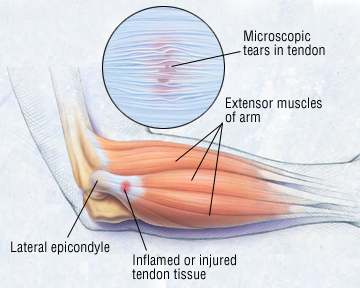
During surgery, the damaged and weakened portions of the tendon are carefully removed, and the remaining healthy tissue is repaired and reattached securely to the bone. In some cases, the nearby radial nerve may also be released if it is found to be compressed or irritated, a common contributor to tennis elbow pain. The operation is typically performed through a small incision on the outside of the elbow under local or general anaesthesia and is usually a same-day procedure. The incision is closed with dissolvable sutures and protected with a waterproof dressing, and a back-slab or splint may be applied to immobilise the joint during the initial healing phase. This is very dependent on the specific surgeon’s opinion, as some patients may not be immobilised at all.
Rehabilitation plays a vital role in recovery. For the first 2-4 weeks, the wrist may be kept still to protect the repair, although patients are encouraged to gently move their fingers, elbow and shoulder to prevent stiffness. Again, this instruction is very specific to the surgeon that has performed the operation. The wrist brace is gradually weaned off. Gradual strengthening exercises are introduced from 8-12 weeks post-surgery, with most patients regaining full movement and light function by this stage. Heavier lifting, gripping, and eccentric loading of the wrist extensors are avoided for the first three months to ensure proper tendon healing.
Most patients return to normal daily activities within 3–6 months and to sports or heavy work soon after, depending on their progress.