
Distal Biceps Tendon Repair
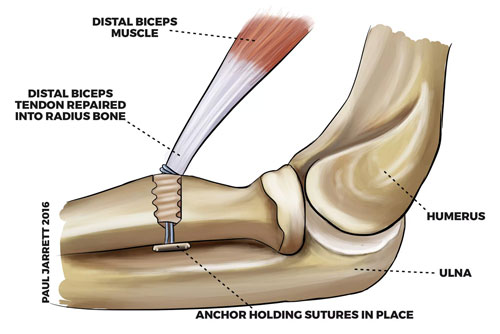
Distal biceps tendon repair is performed to reattach the biceps tendon to its original position on the radius bone near the elbow after it has torn away, usually as a result of a sudden force or heavy lifting. The distal biceps tendon is essential for turning the palm upwards (supination) and bending the elbow (flexion), and when it ruptures, patients often experience pain, swelling, and weakness in these movements. Surgical repair restores strength, function, and endurance in the affected arm and helps prevent long-term limitations.
During the procedure, the surgeon reattaches the tendon to a part of the radius which is the natural anchor point for the biceps. In most cases, this is achieved through two small incisions: one at the front of the elbow to locate and prepare the tendon, and another at the back to access the bone. Sutures are woven through the tendon and secured into small drill holes in the radius, bringing the tendon back to its anatomical position. Once the repair is complete, the elbow is moved through its normal range of motion to confirm stability before being supported in a sling.
After surgery, the arm is kept in a sling for comfort and protection, though gentle movement begins the next day to prevent stiffness. It is essential for you to be guided by the surgeon / physiotherapist because not all normal movement is encouraged. The early exercises focus on active assisted flexion (with the assistance of the opposite hand to avoid strain on the repair) and gradual gravity assisted extension (avoiding the full extension in the early stages). The sling is worn full-time for the first few weeks and gradually reduced around the four-week mark. Lifting is restricted to very light objects, no heavier than a cup of tea, for the first three months, with strengthening and heavier use introduced gradually thereafter.
Most patients regain full range of motion and strength within four to six months, depending on adherence to the rehabilitation program. Desk-based work can usually resume within a week or two, while manual or physically demanding jobs may require up to six months before returning safely. Complications are uncommon but can include nerve irritation, stiffness, or rare re-rupture of the tendon. With careful surgical technique and guided physiotherapy, distal biceps repair offers excellent outcomes, restoring power, stability, and normal arm function.